
Table of Contents
This post contains affiliate links. If you buy through them, we may earn a small commission at no extra cost to you.
SSD and DRAM Prices, Apple Price Increase, AI Boom, and the Chip Shortage: What’s Really Going On?
If you’ve been eyeing a new Mac, gaming laptop, or AI-ready workstation lately, you’ve probably noticed something painful: prices are creeping up, lead times are getting longer, and the “base configuration” that used to feel comfortable now looks underpowered. Apple and Microsoft have both made headlines recently with price hikes on their latest hardware, and they’re not alone. Under the surface, a massive shift is happening in the tech world—and AI is at the center of it.
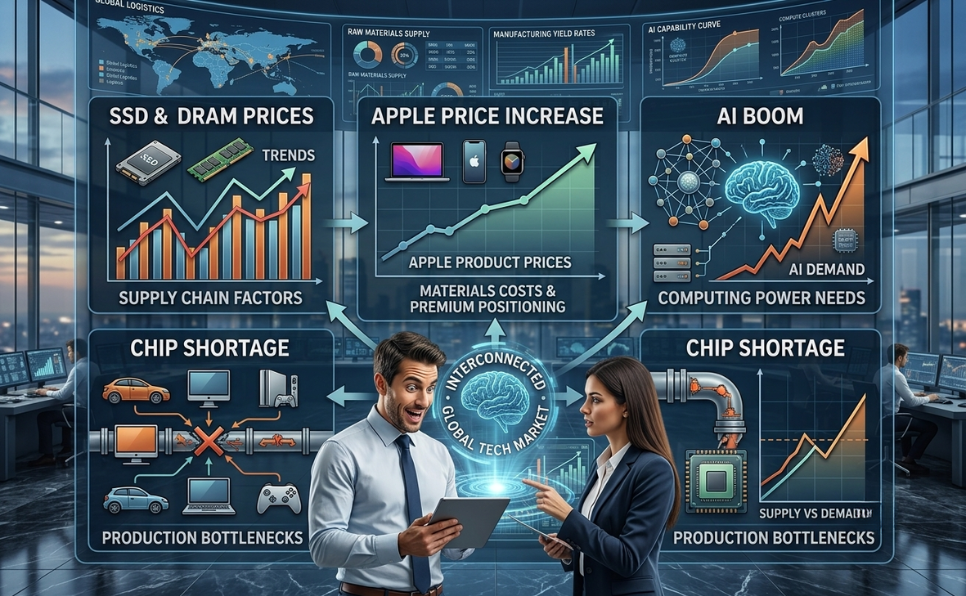
The buzz around artificial intelligence isn’t just about cool demos and viral chatbots. Behind the scenes, AI is reshaping the entire hardware ecosystem, driving a huge spike in demand for SSD storage (NAND) and memory (DRAM). That surge in demand is driving price increases of 3X to 5X in certain categories, sending shockwaves through the AI PC market and beyond.
Let’s unpack what’s really going on, why SSD and DRAM prices are rising, and what that means for your next upgrade.


Memory and Storage 101: The Powerhouses of Modern Computing
To understand why demand for SSD and DRAM prices is exploding, it helps to start with the basics.
Every computer you use—whether it’s a MacBook, a Windows laptop, a gaming PC, or an all‑in‑one—relies on two critical components:
- Storage (SSD / NAND): This is where all your data lives. Your operating system, apps, files, photos, videos, and project assets are all stored on an SSD. Think of it as the long‑term memory of your machine.
- Memory (DRAM / RAM): This is your system’s working space. When you open an app or a file, your computer pulls data from the SSD into memory so it can process it quickly and deliver real‑time responses.
A simple way to visualize it:
- The SSD is your fully stocked workshop.
- RAM is the active workbench where you lay out your tools and materials to get things done.
The more complex your tasks—editing 4K video, working with 3D renders, running multiple virtual machines, or using AI-assisted design tools—the more storage and memory you need. Users who work in 3D animation, graphic design, gaming, content creation, and audio/video production rely on high-capacity SSDs and generous RAM to keep everything running smoothly without lag or stutter.
That’s why modern systems, especially those in the AI PC market, are being configured with larger SSDs and more DRAM than ever before. And that’s exactly where the pressure on global supply starts to mount.
Why Demand for SSD and DRAM Is Surging
On paper, the spike in SSD and DRAM prices might look sudden, but the trend has been building for a while. A small number of major players—companies like Samsung, SanDisk, Micron, and Hynix—produce most of the world’s storage and memory.
These manufacturers:
- Build components for their own branded products.
- Supply other big tech companies as OEM partners.
Over the last few years, prices across different categories of SSDs and DRAM have climbed anywhere from 10% to 75%. The core issue isn’t just price—it’s the combination of rising demand, volatile supply chains, and aggressive purchasing behavior from big buyers.
Because demand is growing faster than many forecasts predicted, companies are scrambling to secure enough components. They’re placing bigger orders earlier and paying more to lock in supply, so they’re not caught short. That competitive rush further tightens supply and reinforces the price pressure on SSD and DRAM.
This was already happening before AI went mainstream. Then the AI wave hit—and everything accelerated.
How AI Became the Main Culprit
The current AI boom is unlike previous tech cycles. Instead of just needing a bit more CPU power or a slightly faster GPU, modern AI models demand a huge amount of high-bandwidth memory and fast SSD storage.
Here’s what’s driving the spike in AI hardware demand:
- AI Servers Everywhere
Companies are no longer content with just traditional data servers. They’re building or renting dedicated AI servers to train and run large language models, generative image tools, and agentic AI systems tailored to their business. - Data-Hungry AI Models
Training and running AI models require massive datasets, which must be stored, accessed, and processed at high speed. That means more SSD capacity and faster DRAM, especially in AI-ready PCs and servers. - Explosive Content Workloads
AI is now used to generate images, videos, 3D designs, marketing content, and complex data visualizations. These workflows constantly create and move large files, placing even more stress on storage and memory.
As more organizations jump into AI, they all need similar things: high‑performance servers, powerful workstations, and client devices that can handle AI-assisted workloads. That’s why we’re seeing notable shifts not just in data centers but also in personal machines—laptops, desktops, and all‑in‑ones designed with AI at the core.


Apple, Microsoft, Dell, and the New AI-Ready Lineup
You can already see this trend reflected in the latest hardware lineups and pricing moves.
- Apple has pushed hard into the AI-ready PC space with Apple Silicon. Its latest M‑series chips are designed to handle intensive tasks, including AI and machine learning workloads. Configurations can scale up to:
- Up to 8TB of SSD storage
- Up to 128GB of unified memory
That kind of configuration isn’t just for show. It’s aimed at creators, developers, and professionals who expect to run AI tools locally and juggle heavy workloads.
At the same time, Apple has introduced price increases across Macs, iPads, iMacs, and several accessories. Even a “normal” configuration—like a MacBook Air with 32GB of RAM and 1TB of storage—can take months to ship. That wait time highlights how tight the supply has become for high-spec components.
- Microsoft has rolled out new machines with noticeable price hikes as well, positioning them as powerful options in the AI PC market.
- Dell, on the Windows side, is doubling down on systems powered by GPUs like Nvidia RTX and promoting them as AI-ready PCs and servers, targeting professionals and enterprises that want to future-proof their infrastructure.
All of these moves are rooted in the same reality: AI workloads demand serious hardware, and that hardware is built on SSDs and DRAM that are now in heavy demand.
Will SSD and DRAM Prices Come Back Down Soon?
Here’s the uncomfortable truth: don’t expect this trend to reverse overnight.
Industry experts suggest that elevated demand for high-bandwidth memory, SSD storage, and server‑grade hardware is likely to continue for at least the next 3 to 5 years. As more businesses adopt AI-driven tools and more users expect AI-enhanced experiences on their personal devices, the pressure on the supply chain will stay intense.
At the same time, companies running legacy software stacks are being pushed to modernize. To stay competitive, they’re starting to adopt AI-compatible platforms and workloads, which further fuels the upgrade cycle.
So, between:
- AI infrastructure build‑outs,
- next‑gen AI PCs,
- and the steady rise in content‑heavy workflows,
There’s no clear sign that SSD and DRAM prices will suddenly fall back to previous levels in the short term.
Should You Upgrade Now or Wait It Out?
This brings us to the big practical question: Is now the right time to upgrade your hardware?
On one hand:
- Major players like Apple, Microsoft, and Dell have already increased prices to align with their own demand forecasts.
- If your current system is low on storage and memory, you’re probably already feeling the pain—slow performance, constant “disk full” warnings, and limited headroom for new tools or AI-assisted workflows.
On the other hand:
- Some people view the rush toward AI-ready hardware as a bit of FOMO—fear of missing out—created by aggressive marketing and hype.
The reality sits somewhere in between. If your current device genuinely struggles with your everyday workload, especially with newer creative or AI-driven apps, waiting may cost you more in lost productivity than the price difference between devices.
A smart way to look at it:
- If your work is increasingly digital, data-heavy, or creative, moving to a higher-efficiency configuration—more SSDs, more RAM, and a modern CPU/GPU—is less a luxury and more a baseline requirement.
- If your current setup still handles your tasks comfortably, you might have some breathing room. But keep an eye on how fast AI features are being baked into the tools you use.


The Verdict: Prepare for the Next AI Wave
We’re only at the beginning of what AI will mean for everyday computing. From the AI PC market to cloud-based AI services, the entire stack is shifting. That shift is putting sustained pressure on SSD and DRAM prices and is already reflected in the latest Apple price increases and similar moves across the industry.
The key takeaway: it’s better to be proactive than reactive.
- Don’t wait until your system becomes a bottleneck at the worst possible time.
- Plan your next upgrade with AI hardware demand in mind—assume that future tools will expect more storage, more memory, and more bandwidth.
- When you do upgrade, aim for a configuration that can comfortably handle AI‑assisted workflows, not just today’s bare minimum.
The next wave of AI disruption is coming either way. Being equipped—not scrambling to catch up—will give you a real edge when it hits.